

Bill Filed To Make E-Verify Mandatory
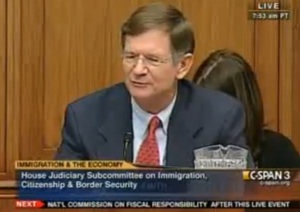 House Judiciary Committee Chairman Lamar Smith (R-TX) has introduced the Legal Workforce Act (H.R. 2164), a bill that calls for improvements in the E-Verify system and makes it mandatory for all U.S. employers.
E-Verify was created in the Illegal Immigration Reform and Immigrant Responsibility Act of 1996. It allows employers to electronically verify that newly-hired employees are legally authorized to work in the U.S. According to a recent Rasmussen poll, 82% of likely voters think businesses should be required to use E-Verify.
Today, over 250,000 American employers voluntarily use E-Verify and an average of 1,300 new businesses sign up each week. Outside evaluations have found that the vast majority of employers using E-Verify believe it to be an effective and reliable tool for checking the legal status of their employees.
Below is a summary of some of the major components in H.R. 2164:
Repeals I-9 System: Repeals the current paper-based I-9 system and replaces it with a completely electronic work eligibility check.
Gradual Phase-In: Phases-in mandatory E-Verify participation for new hires in six month increments beginning on the date of enactment. Within six months of enactment, businesses having more than 10,000 employees are required to use E-Verify. Within 12 months after enactment, businesses having 500 to 9,999 employees are required to use E-Verify. Within 18 months after enactment, businesses having 20 to 499 employees must use E-Verify. And within 24 months after enactment, businesses having 1 to 19 employees must use E-Verify.
Agriculture: Requires that employees performing “agricultural labor or services” are only subject to an E-Verify check within 36 months of the date of enactment. Under the bill, an individual engaged in seasonal agricultural employment is not considered a new hire if the individual starts work with an employer for whom they have previously worked.
Federal Preemption: Pre-empts state laws mandating E-Verify use for employment eligibility purposes but retains the ability of states and localities to condition business licenses on the requirement that the employer use E-Verify in good faith under the federal law.
Safe Harbor: Grants employers safe harbor from prosecution if they use the E-Verify program in good faith, and through no fault of theirs, receive an incorrect eligibility confirmation.
A copy of the bill can be found at FarmEquip.org/Shortlink. ◆