

What Agriculture Can Expect from Washington
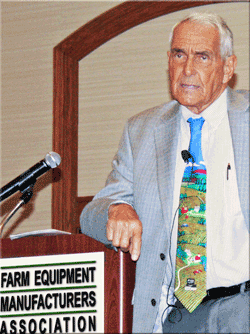
by Jay Lehr, Ph.D., Science Director, The Heartland Institute & Speaker at the 2011 St. Louis Fall Convention
 In my 50 years of experience with farm legislation, there has never been a greater mystery as to what the next six year phase of farm support legislation may hold for American Agriculture. For decades many have predicted there would not be a “next” farm bill and of course the strong political power of America’s breadbasket proved that they were always wrong. It will still be wrong when Congress gets done debating what subsidies will be between 2012 and 2018, but never has it been a greater mystery, all because of the pressure on cutting our nation’s budget.
On November 23, the super budget committee of Congress will report to the President on how they plan to cut 1.2 trillion dollars from the U.S. budget over the next decade. There is no doubt that as little as we know of the farm bill, we definitely know it will be in the cross hairs of the budget cutters. Sadly, few Americans know that as much as 60% of the cost of the perennial farm bill goes to food stamps and other programs to bring food to the poor — including the school lunch programs.
Conventionally, farm support has consisted of minimal direct payments to farmers with a historical record of farming set amounts of acres of various crops and harvesting average yields over a certain time period. For this they may receive a small stipend per bushel of grain. They must also agree to fix that farm acreage and not over produce on additional acreage. Additionally the government guaranteed a price support through what are called counter cyclical payments to make up the difference between the market price of a grain and minimum support payment guaranteed by the government. In recent years, money has been paid to farmers for improving various environmental aspects of their land.
Possibly the least controversial farm support program is government subsidized crop insurance, which is not likely to be reduced from the farmers standpoint, but the amount kept by the insurance companies who sell the insurance on behalf of the government could well be cut.
Frankly over the years, the various programs available to farmers have become so complex that few farmers understand them without the aid of assistance from advisors or extension agents. But the bottom line is that really no one has a clue what will come down in 2012 — if in fact time even allows passage of a farm bill with so many other issues on the table in an election year.
What agriculture knows for sure is that this administration has not been friendly to agriculture as a result of continuously more stringent and unnecessary regulations handed down from U.S. EPA, continued support of renewable energy such as wind and solar which will drive up electricity rates and an unwillingness of the department of Interior to allow development of much of our nations wealth in fossil fuels which would lower fuel costs on the farm. Additionally the department of labor has refused to look seriously at a guest labor program to harvest fruits and vegetables, some of which end up rotting on the vine.
On November 23, we may know a little more about a potential 2012 farm bill and then again we may not — but we know for sure that agriculture is not going to prosper under a continuation of this administration’s attitude toward small business in which 99% of the nation’s farms can be counted. While my crystal ball may be no more accurate than the next ag futurist, I am willing to bet that direct payments will be gone from the next farm bill, that counter cyclical payments will remain with support levels well below current prices, that money for environmental improvements will be drastically cut and the crop insurance programs will remain.
Continued From Page 1: One very positive change will involve strong limits on the gross income levels of farms and corporations that can take advantage of a farm bill meant to benefit the normal family farm.
I do not need a crystal ball to tell with certainty how the current administration will deal with ag related issues in other areas. Secretary Gates who was previously retained by President Obama to oversee the military went on record to support increased ethanol and biodiesel throughout the military, so existing legislation already supporting biofuels will not be dismantled and could even be enhanced. Our newly appointed Secretary Panetta is not likely to change this approach.
Environmental groups have always been opposed to all genetic modification, so progress in this technology will be slowed during the remainder of this administration which supports all the goals of the major environmental activist groups. While essentially everything you have ever heard negative about genetically engineered seeds is simply false, fears among some still exist. Safety restrictions placed upon the development of genetically modified grains are ten times greater than were ever demanded of standard hybridization over the past half century although hybridization was a more hit or miss procedure. Slowly but surely resistance to genetically modified food is declining and its use is increasing but its advance under this administration is definitely uncertain.
Michelle Obama will play a major role in the growth of organic farming for the remainder of this administration. She has already planted a well publicized organic garden at the White House. It is likely that the administration will support organic farming to the detriment of conventional.
Perhaps the most negative impact this administration will have on agriculture will be its continuing efforts to support the funding of wind and solar projects that have absolutely no chance of offering economic additions to our electric grid so the result will definitely be higher electricity costs. Concurrently the administration is making it difficult for the nation to continue to develop its vast fossil fuel energy resources now known to be greater than any nation in the world.
Related to the governments unfortunate drive to develop wind, solar, and electric cars is their belief that the government can alter the climate of the nation and planet by reducing carbon dioxide emissions which has absolutely no scientific support whatsoever.
Finally, let me comment on the government’s unrelenting application of the endangered species act which has only endangered farms finding animals the government usually quite incorrectly considers endangered. A good example is the polar bear whose numbers in the arctic have increased from 5000 to 22000 in the past 30 years.
The bottom line is that this administration is not in any significant way friendly toward agriculture or as previously mentioned any small business in the nation. Now let’s see what happens in the next year. Hang on for the ride!