

Agricultures Share
Larry Combest, the former chairman of the U.S. House Ag Committee and Keynote speaker at our just completed Spring Clinic in Biloxi, had several words of warning for those interested in a 2012 Farm Bill. Just because we have incumbent members of congress who have supported ag policies in the past, doesn’t necessarily mean they can be counted on this year.
Combest warned those in attendance that many areas of the country, which have a history of being pro-agriculture are also strongly conservative. Many congressional members are facing strong primary challenges from within their party from candidates demanding cuts in federal spending and a more limited role for the federal government.
These challenges from the right, leave members of Congress with the dilemma, is this ag policy vote a good vote or are my ultra conservative friends going to want me to vote against everything?
In defending the agricultural policy he crafted ten years ago, Combest pointed out that starting in 2002, there is not another agency in government that has spent less money, based on what was projected, than agriculture.
“We have done our part… we have taken our share of cuts.” 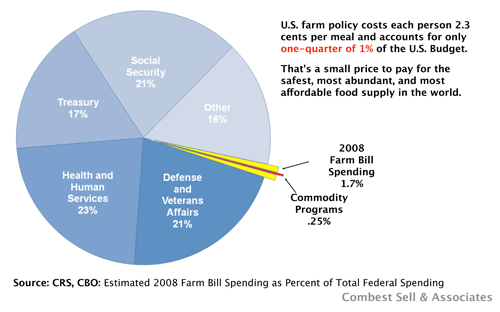
One of the most important programs, crop insurance, took a $6 billion hit two years ago, and now there are those who would cut even this program more. Combest continues to believe it’s not necessarily how much money you have to spend, it’s how good the policy is.
Based on what we know today, here is what Combest believes we are likely to see coming out of Washington before the current Congress ends business in December.
In May or June the Senate Agriculture Committee will likely write a Farm Bill using the $23 billion savings goal that was agreed to last fall by the Chairs and Ranking Members of the House and Senate Agriculture Committees. The House Agriculture Committee will likely write a Farm Bill using a higher number, probably the $33 billion figure that the Biden Group embraced last fall and the President proposed in his budget.
Like the Administration’s proposed budget, the House budget resolution developed by Chairman Paul Ryan (R-WI) is not binding on the Farm Bill. The Senate will again fail to pass a budget, thus the budget process is a nonevent as far as the Farm Bill is concerned.
On a totally separate track from the Farm Bill, Combest reminded our members that the House budget resolution includes reconciliation instructions that are binding on all House committees.
The reconciliation in-structions require House committees to produce cuts. The House Agriculture Committee is expected to produce $33 billion in cuts, with all expected to come from SNAP (Food Stamps) in a non-Farm Bill piece of legislation. This will be a partisan exercise in Committee. The partisanship will intensify on the House floor when all committee-reported bills are combined into one budget-cutting reconciliation bill and voted on along party lines. The House bill will be “dead on arrival” in the Senate. This exercise in fiscal austerity is likely a prelude to a lame duck session strategy.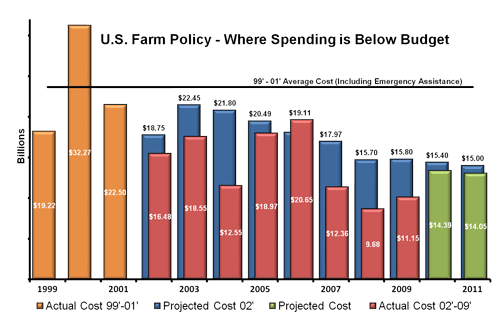
The most controversial title to the Farm Bill is the Commodity Title. Some key substantive issues to sort through in this title include how to construct an FSA-delivered revenue program, how to limit the negative impact of this revenue program on crop insurance, how to gain southern lawmaker support to obtain a near-universally supported Committee bill, and old and new issues percolating on dairy.
Successfully moving a Farm Bill across the Senate floor is considered a dubious proposition if the Senate Agriculture Committee is united, but near impossible if it is not.
There are political risks to taking up a Farm Bill for both sides. For some Republicans effectively blocking a Farm Bill may underscore obstructionist claims and upset rural swing voters but please others in the conservative base. Democrats are open to hot-button, non-germane amendments offered to a Farm Bill considered on the Senate floor. This is why some believe the full Senate is unlikely to take up the Farm Bill until after the election unless the majority believes there may be a political point to be made by taking the Farm Bill up without the likelihood of passage.
Combest does not anticipate House floor action on a five year Farm Bill marked up in Committee prior to the election, unless the full Senate successfully approves a Farm Bill in which case that is at least a possibility.
Sometime in the fall, he anticipates the House passing a one year extension in advance of fall planting. But advocates of a Farm Bill in the Senate may oppose a one year extension at this time because they feel passage of an extension would take pressure off completion of a five year Farm Bill. Opponents in the Senate might oppose extension due to philosophical objections.
After the election, among other things, Congress is expected to turn its attention to turning off sequestration at least for fiscal year 2013. This is expected to restart a mini-super committee process where offsets are sought to achieve this goal. Under this scenario, the House and Senate Agriculture Committees would then pre-conference their respective committee-passed Farm Bills and the final product would be incorporated into a larger bill to turn off sequestration. This product would contain a one year extension because December approval of a five year bill would provide inadequate lead time for USDA to implement the new law.
Combest ended his keynote address to our Spring Management Clinic with the following admonition: “The ability to feed, clothe, and fuel ourselves is a national security priority. That’s why we must take a stand, I urge you to ‘hold the thin green line’ of U.S. farmers with sound policies, so that they can continue to provide us with the safest, most affordable and most abundant food supply in the world.”
We are extremely thankful for Larry Combest’s willingness to share his views and insights into a process that, while complicated, is important for our members to understand, as the outcome will impact our members and the U.S. for many years.