

Drought & Above Average Temperatures Grip The Nations Farmland
Over 1,100 Nebraska farmers have been ordered by the state’s Department of Natural Resources to halt irrigation of their crops because the rivers from which they draw water have dropped due to a worsening drought.
The orders come as the central U.S. succumbs to the worst drought in a quarter century which has parched corn and soybean crops and sent prices of both commodities to near-record highs.
Orders have been sent to a total of 1,106 farmers in the country’s No. 3 corn producing state and fourth-largest soybean state, the department confirmed.
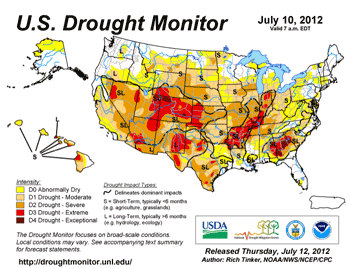 The orders affected only irrigation systems that draw from surface water, mostly rivers and creeks, and not systems that draw from wells, a department spokesman said. Nearly the entire state is under some level of drought, more than half of it classified as severe drought or worse, according to the weekly U.S. Drought Monitor.
Roughly half of the cropland and pasture in Nebraska is irrigated, unlike other top crop producing states like Iowa and Illinois which rely largely on rainfall.
Elsewhere, more than 1,000 counties in 26 states are being named natural-disaster areas, the biggest such declaration ever by the USDA, as drought grips the Midwest.
The declaration makes farmers and ranchers in 1,016 counties — about a third of those in the entire country — eligible for low-interest loans to help them weather the drought, wildfires and other disasters, Agriculture Secretary Tom Vilsack said. The USDA is also changing procedures to allow disaster claims to be processed more quickly and reducing the penalty ranchers are assessed for allowing livestock to graze on land set aside for conservation.
Moderate to extreme drought now covers about 53% of the Midwest, the country’s main growing region, fueling crop-price gains that are the biggest this year among the 24 commodities tracked by the Standard & Poor’s GSCI Spot Index.
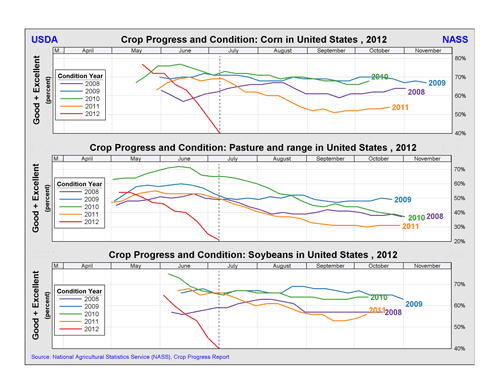 USDA rated the corn crop at 31% good to excellent and soybeans 34% good to excellent, with ratings cuts of each crop steeper than analysts expected. The top two corn producing states in the country, Iowa and Illinois, showed huge declines in crop prospects. Corn in Iowa fell from 46% good-to-excellent last week to only 36% this week. In Illinois, the crop plunged to 11% from 19% good-to-excellent.
The crop in Missouri, the worst hit by the drought, fell to 7% from 12%, while Kentucky’s crop improved slightly to 6% from 5%. The drought also pummeled the soybean crop, which was rated 34% good-to-excellent, down 6% points from the previous week and one point below estimates for 35%.
The secretary called on Congress to pass a five-year reauthorization of all agricultural programs before Sept. 30, when current authorization expires, to enhance the department’s ability to help farmers and ranchers in times of need.
Congress needs “to have that bill come to the floor and be voted on,” Vilsack said.