

Stalled Farm Bill Puts All At Risk
In mid-July of this year, we used this newsletter to praise the work of the House Agriculture Committee, Chairman Lucas and Ranking Member Peterson in passing the Federal Agriculture Reform and Risk Management Act of 2012 on a bipartisan vote of 35-11. At that time, we called for quick passage by the full House of H.R. 6083.
 The farmers and ranchers who take extraordinary risk, deserve the opportunity to hedge against uncertainty and ensure that yield losses, price declines, and revenue dips do not put them out of business. The House Committee bill provides that certainty for farmers, which would allow them to make long-term investments necessary for maintaining productivity and economic viability.
We are disappointed, as are many in our industry, that the House leadership has yet to assemble the votes needed for passage of the Ag Committee’s work.
Ben LaCross, a fruit grower in northern Michigan, recently wrote for the Farm Bureau’s Focus on Agriculture; “Agriculture understands the importance of being fiscally responsible. Farmers are ready to do their part to reduce the national deficit. In fact, this bill would have saved taxpayers more than $23 billion, compared to previous farm bills. The bipartisan House Agriculture Committee-passed bill would have saved taxpayers even
more.”
Some members of the U.S. House of Representatives are now considering a strategy that would involve getting 218 members to sign a discharge petition that would bypass the ordinary procedures and bring the farm bill up for a vote by the House. Others are working on a plan that would take the Senate passed bill directly to Conference Committee with the House, where differences could be resolved.
While we welcome any real movement on this important issue, a symbolic House vote, lacking votes for passage, is not progress.
 During his visit to Charlotte, NC for his party’s national convention, Ag Secretary Tom Vilsack put the full blame for the lack of movement of the Farm Bill on House Republican Leadership. Noting that President Obama has called on Congress to pass the farm bill, Vilsack said, “What we are seeing is a delay on the Food, Farm and Jobs Act that is in part a Republican attempt not just to reduce nutrition assistance but the farm programs and crop insurance.” The secretary also noted that House Budget Committee Chairman Paul Ryan (R-WI), now the Republican vice presidential nominee, has proposed “a $134 billion cut in nutrition assistance, which not only impacts the recipients but also farm income.”
It’s unlikely you could find a more partisan atmosphere to seek support for a Farm Bill. The need for passage of new Farm Bill legislation is clear, regardless of the political climate. There is no acceptable reason for putting the livelihood of the nation’s agriculture industry and rural communities at risk.
The Farm Equipment Manufacturers Association again calls for quick passage of the Farm Bill produced by the House Ag Committee.
We urge members to stay in contact with their members in Congress on this important legislation. Ask the hard questions and urge them to produce a five-year Farm Bill that will provide some level of stability for all of our producers.
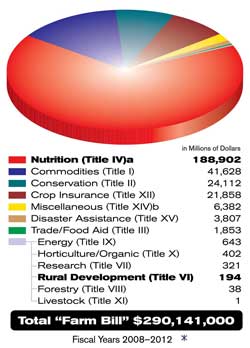
* Graphic Source: Congressional Research Service – Cost that were projected.
http://dakotafire.net/farms/where-does-the-farm-bill-money-go/1295/