

Oversupply Of Steel, Calls For Mill Shutdowns
Global steel has a big problem: It’s too big and it’s getting bigger. The Wall Street Journal reports that steel mills around the world have a production capacity of 1.8 billion tons but will take orders for only 1.5 billion tons, this year. And instead of consolidating and becoming more efficient, the industry is still building more capacity.
By 2016, an estimated 100 new mills, with total estimated supply capacity of 350 million tons, are expected to come on stream, according to industry executives and consultants. Companies in Vietnam, Argentina, Ecuador, Peru and Bolivia, all backed in some way by their governments, are building or planning new mills.
“You can argue about what needs to happen next,” said Charles Bradford, an analyst with New York-based Bradford Research Inc. “But no question: there is too much capacity.”
Getting a definite count on the number of steel mills in the world and actual production capacity is difficult in large part, say industry officials and analysts, because there are hundreds of small, uncounted mills in China, which accounts for 46% of world steel output. Estimates for the number of steel mills in China range from 600 to 800 mills.
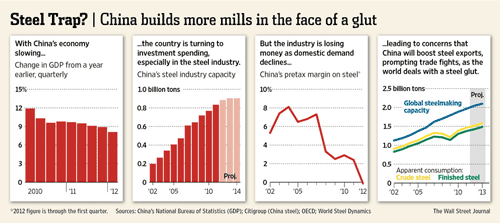

The oversupply issue has reduced steel prices and profits, as seen in the latest round of earnings, and led to renewed calls for consolidation and rationalization among industry officials and investors.
“Steel needs a major player to buy underperforming mills and shut them down,” says Tim Cahill, a Dublin-based analyst for J&E Davy Holdings Ltd. Without that, he says, steelmakers lack economies of scale needed to gain significant savings in transportation and production, or muscle in negotiating with both raw-material suppliers and customers such as auto and appliance makers.
Prices of hot-rolled coil steel in the U.S. have fallen over 35% to $636 a ton from over $1,000 a ton before the 2008 financial crisis.
Without consolidation, big steel companies say they will have to rely on other methods to stay healthy. Those include developing better high-margin, high-tech, light-steel products for the auto sector, cutting costs and selling more in emerging markets.
U.S. Steel Chief Executive John Surma said recently his focus was on “things we can do inside the company.”