

Survey Shows Higher Than Expected 2012 Farm Income
The Federal Reserve Bank of St. Louis, in a recent survey from 61 agricultural banks located within the boundaries of the Eighth Federal Reserve District, said that abundant crop insurance shielded farmers’ income from much of the impact of this summer’s record drought across the Midwest and Mid-South. The Eighth District comprises all or parts of the following seven Midwest and Mid-South States: Arkansas, Illinois, Indiana, Kentucky, Mississippi, Missouri and Tennessee. It is broken into four zones: Little Rock, Louisville, Memphis and St. Louis.
On average, lenders across the District reported fourth quarter income and spending were higher than one year ago. In earlier surveys, lenders in the St. Louis and Louisville zones in particular had anticipated that the record drought of 2012 would significantly lower farmer income and capital spending. Instead, crop insurance helped to offset the impact of the drought in the hardest-hit areas.
“The 2012 drought greatly reduced production, but all of our borrowers carried crop insurance,” responded one Illinois agricultural lending bank. “Many farmers had higher levels of coverage. This has resulted in good income for most, and most will carry that income into 2013.”
As of Feb. 4, 2013, Missouri and Illinois farmers have received close to 23% of the $13.7 billion in claims paid out nationally so far on 2012 production; the USDA estimates total 2012 claims will reach a record $21 billion.
In addition, good growing conditions in the southernmost parts of the District (in particular, the Memphis zone) helped produce significantly higher corn and soybean yields in this region. This allowed farmers in these regions to benefit from higher prices for their crops as commodity prices soared this summer.
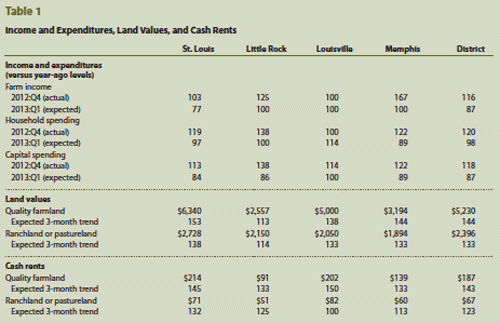
For the Eighth District overall, the survey’s diffusion index value for realized fourth quarter 2012 farm income versus year-ago levels was 116. (This value is based on a diffusion index where 101-200 indicates higher realized income—based on survey responses—than a year ago and 0-99 indicates lower realized income than a year ago. A value of 100 indicates the same as a year ago.) In Memphis, the realized fourth quarter 2012 index value was 167, while in Little Rock, it was 125. Meanwhile, St. Louis and Louisville stayed on pace with a year ago with levels of 103 and 100 respectively.
Looking ahead to the first quarter of 2013, most lenders except those in the St. Louis zone were expecting farm incomes to remain steady. At the same time, lenders across the District expected a decrease in first quarter 2013 capital spending compared with a year ago. A tax provision for accelerated depreciation on qualifying farm asset purchases may have provided a capital spending boost in the fourth quarter 2012 ahead of the provision’s expiration.
Meanwhile, both the value of nonirrigated cropland (or quality farmland) and the value of ranch and pastureland in the Eighth District were expected to continue to trend higher over the next three months.
Lenders estimated that overall District quality farmland was worth an average of $5,230 per acre in the last quarter of 2012, with ranch and pastureland averaging $2,396 per acre. By zone, bankers estimated that quality farmland values averaged $2,557 per acre in the Little Rock zone; $5,000 per acre in the Louisville zone; $3,194 in the Memphis zone and $6,340 per acre in the St. Louis zone.