

U.S. Trade Deficit, Chinese Surplus Continued To Rise
The U.S. and Chinese trade imbalances in manufactures continued to surge in 2012, with the U.S. deficit up by 8%, to $498 billion, and the Chinese surplus by 15%, to $755 billion, as noted in a new report from the Manufacturers Alliance for Productivity and Innovation (MAPI).
For the three years since 2009, the U.S. deficit rose by $172 billion, or 53%, while the Chinese surplus soared by $333 billion, or an extraordinary 79%. The three-year increase in the U.S. deficit resulted in the loss of 700,000 to 1.4 million American manufacturing jobs, including 140,000 to 280,000 jobs in 2012.
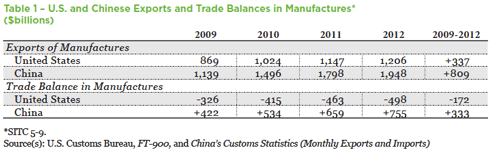
According to the report, the most striking dimension of the U.S.-China trade relationship is the extremely lopsided bilateral trade account. In 2012, U.S. imports of manufactures from China were $417 billion, or 6.3 times larger than the $66 billion of U.S. exports to China, and up from a ratio of 6.1 in 2011. U.S. exports to China were flat in the second half of 2012 while imports were up by 5%.
“Looking ahead, the momentum is toward still larger trade imbalances in 2013,” Ernest Preeg, MAPI Senior Advisor for International Trade and Finance, predicted. “Less clear but far more important is the longer-term outlook over 5 to 10 years. Opinions vary as to whether the U.S. deficit in manufactures will continue to rise or begin to fall, but it is highly unlikely, on current policy course, that there will be a major decline in the deficit.”
Indeed, Preeg argues, a strong case can be made for a bolder and more forward-looking U.S. policy response to bring U.S. trade in manufactures back into balance. The policy point of departure is that mercantilism is defined as a strategy to achieve a balance of exports over imports, with the deficit-generating impact on trading partners called “beggar-thy-neighbor.” Not only China, but the other three principal exporters of manufactures—the EU, Japan, and South Korea—all have very large trade surpluses in manufactures, while the U.S. is the outstanding beggarly neighbor. Moreover, all four trading partners have current account surpluses, while the United States has an unsustainably large deficit.