

Minimum Wage Laws Dont Create Prosperity
President Obama used his State of the Union address to propose hiking the minimum wage to $9 an hour by 2015, from $7.25, where it has been since 2009. He also proposed indexing the U.S. federal minimum wage to inflation, so that it continues to rise in the future.
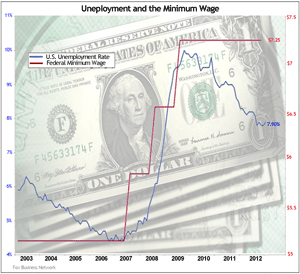 Opponents are correct in pointing out the last minimum wage hike wiped out tens of thousands of jobs and helped aggravate youth and college student unemployment, now stuck stubbornly at 24.6%, higher than historical levels.
The Employment Policies Institute (EPI) has multiple studies showing how minimum wage hikes, “including the one called for by the president, lead to job loss, not job creation, as well as fail to reduce poverty or stimulate the economy,” says EPI spokesman Stephen Ford.
Research published in the Southern Economic Journal from economists at Cornell and American Universities has estimated that a minimum wage hike proposed by the President “would eliminate at least 467,000 jobs,” notes EPI’s Ford. “The study also found that the higher minimum wage would not reduce poverty, as a majority of beneficiaries live in households with incomes about the poverty level.”
Michael Saltsman, research director at the Employment Policies Institute, said in a statement: “The President is entitled to his opinion but the facts are indisputable.” He adds: “Minimum wage hikes lead to job losses. This proposal will only harm the people the President wants to help-especially teens, who have already endured more than four years of 20 plus percent unemployment.”
FoxBusiness reports that for the 10-year period from 1997 to 2007, the minimum wage was $5.15 per hour. Congress raised it to $5.85 in 2007, then again to $6.55 in 2008 and finally to $7.25 in 2009. That means over that three-year span, businesses who rely on minimum-wage workers saw their labor costs jump 41%, right as the economic crackup began.
EPI has also released studies showing minimum wage hikes do not reduce poverty levels; disproportionately harm minorities; and fail to boost the economy. EPI’s Ford adds that a recent study from University of California-Irvine’s David Neumark purportedly found that separate research proving wage hikes don’t reduce employment “are without merit.”
“Using a minimum wage increase to create jobs is like using an oven to create ice cubes-it just doesn’t work,” said EPI’s Saltsman, adding, the President instead “needs to lower barriers to hiring-not raise them.”
Sen. Marco Rubio (R-FL) is against Obama’s push to raise the minimum wage to $9 an hour. “I support people making more than $9. I want people to make as much as they can. I don’t think a minimum wage law works,” Rubio told CBS News. “We all support — I certainly do — having more taxpayers, meaning more people who are employed. And, I want people to make a lot more than $9 — $9 is not enough. The problem is you can’t do that by mandating it in the minimum wage laws. Minimum wage laws have never worked in terms of having the middle class attain more prosperity.” What works, he said, is helping the private sector grow.