

Honeybee Study Finds Correlation Between
Pesticides & Fungicides In Colony Collapse Disorder Research
Farm Journal’s AgWeb is reporting a honeybee crisis playing out in California almond fields, where producers can’t get enough hives to pollinate their crops. A high rate of overwinter losses from the 2012 drought and Colony Collapse Disorder (CCD) reduced hives available for deployment.
Almonds, the leading crop dependent on honeybee pollination, are on the bleeding edge of the crisis. “[Farmers] are in a panic,” said David Westervelt, assistant chief of the Florida Bureau of Plant and Apiary Inspection.
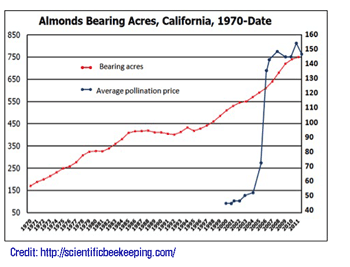 The hive populations are declining, even as demand for their services increases. The result: rental prices hovering at $200 per colony, compared to $150 in 2010 and $58 in 2004. Although scientists have looked for a suspect-from pesticides to parasites-nothing has ever stood out.
In an article published in late July in the journal “PLOS ONE”, scientists at the University of Maryland and the USDA have identified the combination of both pesticides and fungicides that contaminate the pollen the bees use to pollinate crops. Although the authors of the study do admit that they don’t understand how the specific mix of pesticides and fungicides causes Colony Collapse Disorder (CCD), it is the most promising piece of evidence so far as to why an entire beehive would die all at once.
As part of the study, researchers collected pollen from hives on the east coast pollinating cranberry, watermelon, and other crops and fed it to healthy bees. Once fed, those bees showed a massive decrease in their ability to resist infection, especially by a parasite called Nosema ceranae.
When the pollen was examined more closely, researchers found it was contaminated with roughly nine different pesticides and fungicides. In one sample, scientists discovered over 20 agricultural chemicals.
Funding for this study was provided by the National Honey Board and the USDA-ARS Areawide Project on Bee Health.
Dust from neonicotinoid pesticides used by corn producers has been thought by some to be one of the potential stressors. The Corn Dust Research Consortium, a group of representatives from pesticide, seed and equipment companies; corn growers; beekeepers; conservation groups; and U.S. and Canadian governments, is evaluating the impact of the dust. FEMA members have supported this Consortium and are working with the group as they seek answers to this important issue.
Various sectors of the agriculture industry are at stake. Nick Calderone of Cornell University estimates commercial bee pollinators directly contributed $11.7 billion to the agriculture economy in 2012 and another $5.4 billion indirectly. “One-third of the food we eat is directly linked to honeybees,” Epstein notes. “With the description of the honeybee genome, we’re finally coming up with answers,” Epstein added.