

Suppliers To Publicly Traded Corporations Be
Warned About Conflict Minerals Disclosures
“We have to pass the bill so that you can find out what is in it…” may have been said in reference to the Affordable Health Care Act, but many manufacturers who supply goods to publicly traded corporations are learning the quote made famous by the former Speaker of the House, also applies well to other legislation.
Enter the three year old, Dodd-Frank Act, which we were told was written and passed to protect Americans from the excesses and ruthlessness of Wall Street and to streamline the regulatory process.
The title and purpose of the Act would not likely set off alarm bells for most small, family-owned companies manufacturing shortline farm equipment. But, as time passes and the 848 page Act expands to 13,789 pages of rules, even some small manufacturers are feeling the pain of “finding out what is in it,” as former Speaker Pelosi said.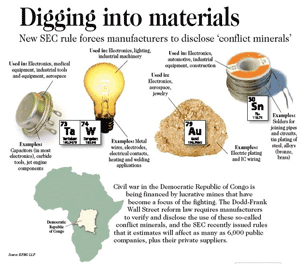
Section 1502 of Dodd-Frank allows the Securities and Exchange Commission to impose a new reporting requirement on all manufacturers who file reports with the SEC. Publicly traded corporations must now disclose whether the products they manufacture or contract to manufacture contain minerals whose sale proceeds may be used to fund armed conflict in the Democratic Republic of Congo (DRC) and surrounding countries. Derivatives of such minerals, identified as “conflict minerals,” include gold, tantalum, tungsten and tin.
Business groups argued in U.S. District Court that the SEC’s rule, was arbitrary, and that forcing companies to make certain disclosures runs contrary to the First Amendment. Last month, U.S. District Judge Robert L. Wilkins approved the government’s request for summary judgment and upheld the law, saying that in developing the final rule, the SEC “appropriately deferred” to the judgment of Congress, which believed the rule would increase peace and stability in the DRC. He also said that the rule does not violate the First Amendment.
To comply with this law, publicly traded corporations are seeking information from direct suppliers on whether the goods they sell contain “conflict minerals”. Direct suppliers in turn are being required to seek applicable information from the next tier of suppliers. The reporting requirement exists regardless of where components and materials are purchased and regardless of the extent to which “conflict minerals” are contained in the goods purchased by the supplier.
Fall Convention Breakout Session: How suppliers can best deal with these information requests and reports will be addressed with a special breakout session during our Fall Convention in Indianapolis.
We will be adding a page to the Association website FarmEquip.org where we will post updates, legal advice, resources available and allow members to share how they are responding to these requests.
While directed more to publicly traded corporations, the information at the link below does a good job of outlining some of the compliance issues: clm.com/publication.cfm?ID=399.