

‘Fast Track’ Trade Moves Forward
|
Trade Glossary TPA – The Bipartisan Congressional Trade Priorities and Accountability Act, more commonly known as the fast track bill. The measure would renew presidential authority to present trade deals that Congress can endorse or reject but not amend. It would facilitate negotiations on TPP and TTIP. TPP – Trans-Pacific Partnership, a trade negotiation with 11 countries bordering the Pacific Ocean. It includes Australia, Brunei, Canada, Chile, Japan, Malaysia, Mexico, New Zealand, Peru, Singapore, and Vietnam. TTIP – Transatlantic Trade and Investment Partnership, a proposal seeking to liberalize trade between the United States and Europe. PROTESTS –
|
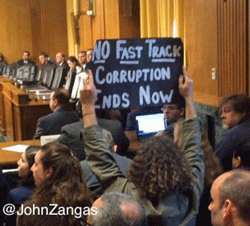
The U.S. Senate Finance Committee last week approved legislation granting presidential authority to negotiate international trade agreements. The bill, the Bipartisan Congressional Trade Priorities and Accountability Act, or the fast-track bill, gives lawmakers the right to set negotiating objectives but restricts them to a yes-or-no vote on trade deals.
The bill’s approval would lay the groundwork for talks on the Trans-Pacific Partnership and the Transatlantic Trade and Investment Partnership.
Agriculture Secretary Tom Vilsack urged quick action on fast-track to simplify and accelerate talks on the Asia-Pacific trade deal. The 11 countries negotiating with the United States are not expected to put their best deals on the table until Congress can pass a fast-track and guarantee that the trade deal won’t change.
Vilsack also said in comments to The Hill that failure to complete the Trans-Pacific Partnership would give China an opening to write the trade rules in the Asia-Pacific, sapping U.S. leverage in the region.
Seventy agricultural organizations support this process and the pending trade agreement in the Asia-Pacific. A statement from the USDA described it as “a 21st-century trade agreement that will promote job growth, increase farm income, generate greater rural economic activity, and help expand U.S. agricultural exports to some of the fastest growing countries in the Asia-Pacific region.”
Labor unions oppose the trade agreement and argue it will hurt U.S. job growth. Among Democrats who oppose the bill is Senate Minority Leader Harry Reid (D-NV), who spoke out against the fast-track bill last week, saying “I have never, ever in my 33 years in Congress ever supported a trade agreement, and I’m not going to start now. So the answer is not only ‘no,’ it’s ‘hell no.’”
Advocates say the law is essential to sustaining the country’s strength.
“TPA is a vital tool to help Americans sell their goods and services to the 95% of the world’s customers living outside our borders,” said Thomas Donahue, President of the U.S. Chamber of Commerce.
As the bills progress, expect a sticking point around establishing a framework to prevent currency manipulation. The Senate Finance Committee rejected a proposed amendment seeking tougher standards to the illegal practice, which uses a government’s control over the money supply to artificially adjust the value of a currency relative to others. Political pundits said last week it could become one of the bills’ significant vulnerabilities.
Global trade policy is an important issue to all segments of the agricultural industry. Our Association encourages all of our U.S. members to make your viewpoint known to your elected members of Congress and the Obama administration. If you need contact information, please let us know, we would be glad to assist. S