

Purdue, CME Group Introduce Tool to Assess Ag Sentiment
Agribusiness executives have another tool to measure the health of the U.S. agriculture economy—this one seeking input from growers.
Purdue University’s Center for Commercial Agriculture, in partnership with the derivatives marketplace CME Group, have launched the Purdue/CME Group Ag Economy Barometer, a monthly economic indicator report that underscores the importance of the ag economy to the U.S. and global economies.

“Purdue’s College of Agriculture has a long tradition of pushing us toward better food security, safety and sustainability with their cutting-edge research,” said Purdue President Mitch Daniels during the announcement earlier this month. “We can imagine no better partner than CME Group to help us analyze and report the real-time economic health of U.S. agriculture, on which literally every citizen and the rest of the economy depend.”
The Ag Economy Barometer, the first of which was released in April, uses survey responses from 400 agricultural producers to develop an index value. Data is based on phone interviews with corn, soybean, livestock, dairy and other producers. They are asked if their operations are in better or worse shape than a year ago, how they view the health of their operation in 12 months, and whether they plan to purchase new machinery or buildings. The survey also asks farmers and ranchers about hot button or seasonal issues such as animal disease and drought.
The barometer provides a value for each month that is relative to the base period—the winter and spring months of 2015 and 2016. Scores above 100 indicate sentiment has improved; scores below 100 suggest decline.
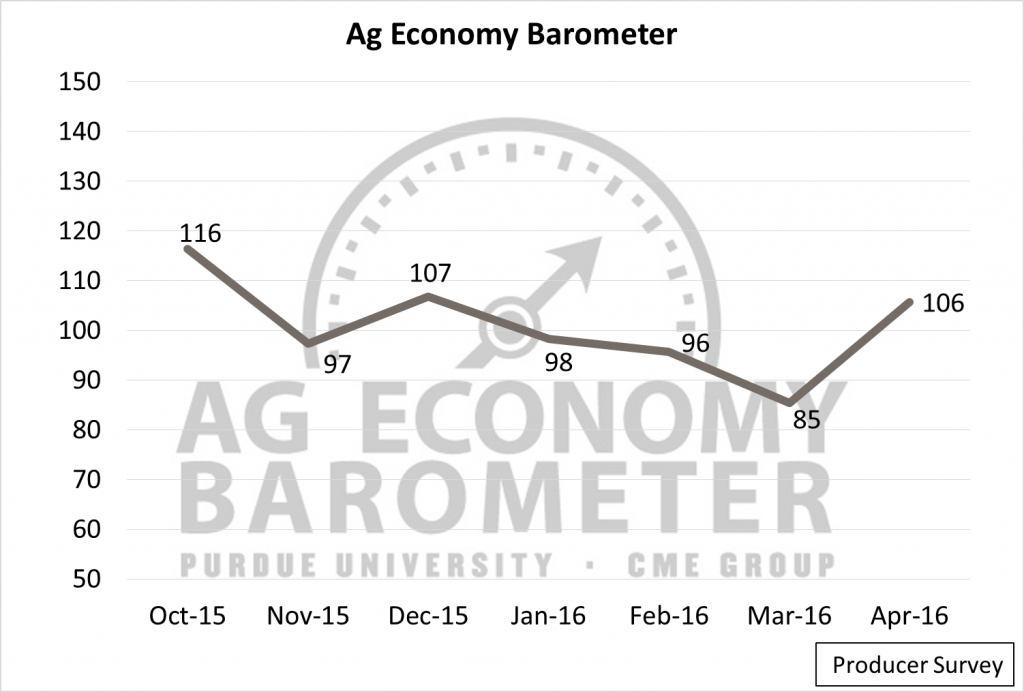
The April survey calculated producers sentiment at 106, which shows sentiment has improved since the base period of October 2015 through March 2016. The increase was driven in part by strengthening corn, soybean and wheat prices.
David Widmar, senior research associate for the Center for Commercial Agriculture and lead researcher on the barometer, warns it is important to keep that uptick in perspective.
“Overall, the general agricultural outlook is still difficult,” Widmar said.
Each quarter, the index will be accompanied by a webinar and in-depth survey of thought leaders, which will include agricultural lenders, business professionals, academics, consultants and commodity association representatives. This survey will be separate from the results of the producer survey. S