

Wind Power Wins Converts in Rural America
BP PLC does big business harvesting energy in and around the farm town of Fowler, Ind. But it isn’t oil and gas—it’s wind.
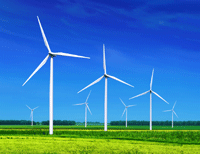
Hundreds of wind turbines ring Fowler, their white towers rising for miles amid the cornfields and soybean plants blanketing much of Benton County, pop. 8,650. The county is home to 560 turbines.
 Wind developers have made $17 million in payments to the county and have spent $33 million on roads, a boon for an economically struggling community that about a decade earlier considered hosting a waste dump to generate jobs and government revenue.
The wind farms took hundreds of construction workers to build and created 110 permanent jobs, mostly wind technicians, who earn about $51,500 a year in Indiana, according to federal data.
President Trump campaigned in part on reviving the U.S. coal industry and has been critical of renewable-energy subsidies. But Republican states such as Indiana, Iowa, Texas and Wyoming have embraced wind for the work and revenue it brings.
Wind supplied just over 6 percent of the country’s electricity last year, and the industry employed close to 102,000 people—nearly double the number working in coal mining, according to federal data.
In the process, the industry has developed powerful allies, including Energy Secretary Rick Perry, who presided over a wind-turbine boom as governor of Texas, and Sen. Chuck Grassley, the Iowa Republican who chairs the Judiciary Committee.
While some in Congress have argued against the federal subsidies that wind energy receives, Grassley said that support helped build an industry that creates jobs and lowers the nation’s need for foreign oil.
“It helps us to be energy independent,” he said, adding that wind’s growing competitiveness with traditional energy sources has diminished the need for wind tax credits, which are being phased out.
Excluding subsidies, it now costs about $47 per megawatt hour to generate electricity from wind in North America over the full lifetime of a facility, compared with $63 for natural gas and $102 for coal, according to a 2016 analysis by Lazard Ltd.
Wind now produces more than 36 percent of Iowa’s electricity, nearly 7 gigawatts of capacity in all, second only to Texas’ 21 gigawatts.
Source: Wall Street Journal