

Manufacturers Use Exoskeletons to Reduce Injuries
Problems such as tendinitis, rotator cuff injuries, carpal tunnel syndrome, and severe back strains account for one-third of all non-fatal workplace injuries, according to the U.S. Bureau of Labor Statistics. It is the most ordinary of manufacturing tasks that cause the injuries: lifting, bending, reaching overhead, pushing and pulling heavy loads, working in awkward body postures and performing repetitive tasks.
To combat the problem, some manufacturers are adopting the use of industrial exoskeletons.
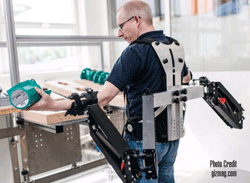
Portrayed in sci-fi movies as super powered suits, these wearable tools offer solutions to the overexertion injury epidemic.
Lowe’s, which began testing the devices last year, describes an exoskeleton like this: It does not have any motors or complex sensors; instead, it has sturdy carbon-fiber rods. When the wearer squats to pick something up, the rods bend, absorbing energy. When the wearer stands back up, the rods spring back. They work passively to make lifting heavy objects slightly easier. The combined strength and flexibility of the carbon-fiber rods means the exoskeleton absorbs most of the brunt when lifting heavy objects. This translates into less wear and tear on employees, which likely means fewer injuries.
According to an article in Industry Week, the devices cost less than $5,000.
Several exoskeleton companies have models ready. They range from passive, mechanical upper-body rigs that attach like a fall harness and prop up arms in overhead welding or assembly jobs, to crazy tele-operated, two-armed tanks that can lift 1,000 pounds or slice through rebar.
Sources: Industry Week, Lowe’s