

Farmers Seek Storage for Soybeans Amid Market Glut
 Caught smack in the middle of the U.S.-China trade war, America’s soybean farmers are taking a huge gamble.
Rather than selling the crop after harvest, they are stashing it in silos, containers, bins, bags, whatever they can get their hands on to keep it safe and dry.
The hope is that over the next few months, trade tensions will ease, and China, the top market for the oilseed, will again buy from American farmers and lift prices.
The scramble for storage comes just as soy production is reaching a record. American growers are trying to recover as overall farm income is projected to fall for the fourth time in five years. Chinese appetite for soybeans had once been a bright spot. But with the onset of tariffs, the country’s imports of the oilseed from the U.S. have plunged, falling almost 90 percent in September from last year.
For some farmers, there is little choice but to keep their harvest. Millions of bushels have nowhere to go. The country’s soybean inventories are expected to more than double to about 955 million bushels by the end of this crop year, according to the USDA.
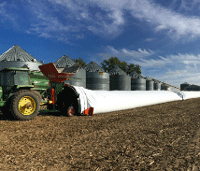
Space for all the extra soy is tight. That’s leading to rarely taken measures, such as piling beans on the ground—risking their exposure to bad weather. More farmers also are stuffing them into sausage-shaped bags that can stretch the length of a football field.
“I’ve heard of farmers and commercial companies putting corn and soybeans into tool sheds and caves,” said Soren Schroder, chief executive officer of Bunge, Ltd., the world’s largest soybean processor.
The tariffs have particularly hit exports from North Dakota, where the expansion of oilseed acreage was a direct result of the growth of Chinese demand. The state plants the fourth-highest number of soybeans in the U.S., and about 70 percent go to Asia.
Illinois, the largest U.S. soybean producer, may have the biggest storage shortfall, needing as much as 100 million bushels for storing crops, said Tim Brusnahan, an analyst with an agriculture brokerage and consulting firm.
As of the start of this month, the Illinois Department of Agriculture had received requests for 11.6 million bushels of emergency storage capacity.
Source: Bloomberg