

Ag Census Confirms Trends, Offers Data to Guide Federal Decision-Making
The once-every-five-years Census of Agriculture was released earlier this month, helping to quantify—and confirm—industry trends.
The 2017 report shows that the numbers of large and small farms are increasing while mid-sized farms are on the decline. Big farms are indeed getting bigger, and we have fewer farmers managing the land. A thin percentage of producers represent a significant majority of all sales. And, as everyone in the industry knows, profits, hence incomes, are down.
 “We can all use the census to tell the tremendous story of U.S. agriculture and how it is changing,” said USDA Secretary Sonny Perdue. “As a data-driven organization, we are eager to dig in to this wealth of information to advance our goals of supporting farmers and ranchers, facilitating rural prosperity, and strengthening stewardship of private lands efficiently, effectively, and with integrity.”
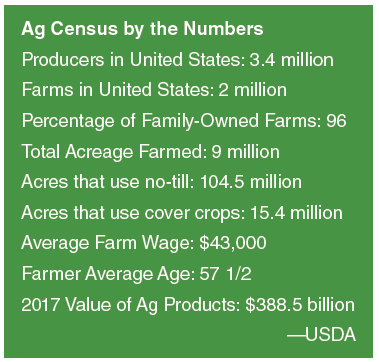
In 2017, there were 3.4 million producers, up nearly 7 percent, operating slightly more than two million farms, down 3 percent. The average farm size increased 1.6 percent to 441 acres between 2012 and 2017.
The overall number of acres being farmed is down by 1.6 percent, which Perdue said signals a loss in arable land.
Farm wages declined 2 percent to just over $43,000, the data tells us. Fewer than half of farmers (43.6 percent) had a positive net cash income in 2017.
Farmers and ranchers produced $388.5 billion in ag products in 2017, with a 50-50 split between crops and livestock. Cattle and calves made producers the most money, followed by corn, poultry and eggs, soybeans and milk.
California leads the nation in ag sales, followed by Iowa, Texas, Nebraska, Kansas, Minnesota, Illinois, North Carolina, Wisconsin and Indiana.
Larger farms continue to capture the lion’s share of production, with the top 5 percent of farms creating 75 percent of all sales. The largest 85,127 farms, which are those with at least 2,000 acres, account for 58 percent of total U.S. farmland.

More than 300,000 producers are under the age of 35, and one out of every four producers has fewer than 10 years of experience. That group has an average age of 46.
More than a third of all producers are female, with 56 percent of farms including at least one female decision-maker. That’s a 27 percent increase over 2012 data.
Perdue said farms with younger producers tends to be larger than farms with older producers.
Various conservation and renewable energy practices also continue to rise. For example, no-till acres increased by 8.3 percent since 2012 with an expanded footprint of about 104.5 million acres. Acres where cover crops were implemented increased nearly 50 percent over the same period to reach about 15.4 million acres.
The National Agricultural Statistics Service, a branch of the USDA, sends surveys to nearly 3 million U.S. farms and ranches. It’s worth noting that about one in four respondents completed the survey online. That number will likely continue to increase as broadband becomes more available. Internet access increased from just under 70 percent to just over 75 percent since the survey in 2012. Sources: USDA, Farm Progress Daily