

Ag Technology Absolutely Essential to Feed the World, Study Says
With total food demand expected to increase by 70% in 40 years, and food prices forecast to rise as much as 100%, there is “enormous opportunity” for innovation and investment in agricultural technology, according to a recently published white paper from the Kauffman Foundation and the Donald Danforth Plant Science Center.
The paper calls on entrepreneurs to “seize untapped potential” for agricultural technology innovation in order to increase food production while minimizing environmental impact, reported the Delta Farm Press.
We need to produce more food in the next 40 years than during the entire course of human history, on a planet showing signs of environmental stress, said the paper’s author, Suren G. Dutia, senior fellow at the foundation, located in Kansas City, MO. He added that investing in agricultural technology is “absolutely essential to meet this goal.”
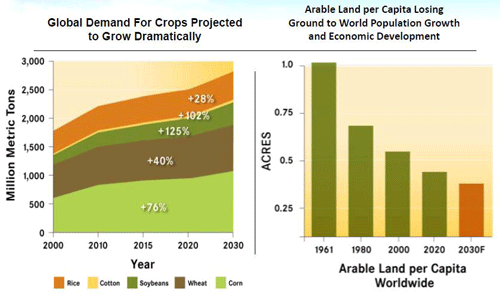
The study asks how humans can feed everyone in a way that sustains the planet. The answer, Dutia says, is agriculture technology that dramatically increases productivity, yet reduces the environmental and social costs of current agricultural production practices.
Ag innovations have tripled worldwide food production over the past half-century, with only a small increase in the amount of cultivated farmland. Agriculture is one of the world’s largest economic sectors, with net farm income around $120 billion, farm assets around $2 trillion, and little leverage.
Data from 900 ag tech companies showed “a robust and steady stream of new business startups in areas of crop and animal production, processing, manufacture, and distribution.” Over the last six years, an average of 132 new ag tech startups launched each year, with the majority in the U.S. heartland and corn belt.
Since the 1980s, public sector financing for agricultural research and development has declined significantly, but private sector funding has increased—over the last decade totaling $8 billion annually for crop inputs and $2 billion annually for animal inputs.
Dutia identifies five major areas in which public and private sector efforts can drive development of agricultural technology: (1) Educate and promote the need and opportunity for ag tech; (2) increase capital flow to ag tech; (3) develop human capital to meet future needs; (4) transition to new technology with “green and lean” efficiency”; and (5), develop regional ag tech entrepreneur support systems to accelerate innovation.
Download the the entire report at bit.ly/1odXq72.