

2014 Farm Bill: Some Win, Some Lose
In signing the Farm Bill at Michigan State University, President Obama said the wide-ranging bill “multitasks” by helping boost jobs, innovation, research and conservation. Obama joked that, “It’s like a Swiss Army knife.” Regardless of the number of blades or provisions, the five-year Farm Bill signed into law last week produced both winners and losers.

Great to see farm equipment other than tractors and combines, the Demco 450 gravity flow wagon was at center stage. Congrats to the folks at Demco for gaining some national attention for their product and "shortline equipment".
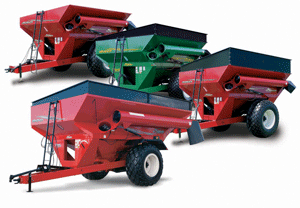 Interesting side note: The company's 750 wagon would require special permiting to move loaded on public roads in Wisconsin from field to field under proposed legislation. Single axle equipment would face even greater issues when combined with the weight of today's high HP tractors and limited to 66,000 lbs total gross weight limits.
Large single axle tilliage equipment is another concern we are addressing with the bills sponsors. Give us a call in the Association office if you would like more detail on the status of the Wisconsin legislation.
Farm Bill Losers
The National Cattlemen’s Association and the National Pork Producers Council failed to eliminate country of origin labeling provisions, among other issues. They claim the provisions will hinder trade with both Canada and Mexico, and those countries will ask the World Trade Organization (WTO) to rule that they are discriminatory.
Conservatives failed in their efforts to reign in out-of-control spending on food stamps. While some groups complained about “savage cuts and starving children,” cuts actually amounted to a mere 1% over ten years in a program rife with fraud and abuse. The law only tweaks rules of a federal heating assistance program that some states had been using to boost food stamp eligibility.
Rep. Alcee Hastings (D-FL) lost a provision that would have would have required better coordination among federal agencies in addressing the decline of pollinator bee populations and required the government to regularly report on the health of birds, bats, bees and other insects.
Rep. Steve King (R-IA) lost his amendment that would allow farmers from other states to sell eggs in California without having to comply with the state’s new mandated hen cage standards.
Farm Bill Winners
Ranchers in Nebraska and the Dakotas will receive help in recovering from an October blizzard with the reauthorization of livestock indemnity and forage disaster programs that had expired. Members of Congress urged the USDA to move quickly to provide relief to ranchers who suffered heavy losses.
Crop insurers scored a major victory from a provision in the bill that bars the Agriculture Department from renegotiating lesser payments to those companies over the five-year life of the bill.
The catfish industry benefits from a provision that moves catfish inspections from the Food and Drug Administration into a new $20 million Ag Department office.
American sugar cane and beet farmers won a sweet victory when attempts to weaken sugar policy failed in five separate votes as lawmakers refused to outsource U.S. sugar production to heavily subsidized foreign producers.
Cotton won provisions important to the industry’s viability, including authorization of a new crop insurance product tailored to cotton production and inclusion of a transition program for the 2014 crop year, as enactment comes too late for USDA and the private sector to offer the new insurance product until 2015. The law’s provisions could help achieve a final resolution of the long-standing Brazil WTO case.
General Provisions
• Eliminates controversial direct payments while maintaining decoupled farm support programs minimizing the possibility of planting and production distortions that can trigger new WTO challenges.
• Allows producers to either maintain existing crop acreage base or reallocate their current base to reflect average acres planted to covered commodities in 2009-2012, a reform that will make programs more relevant and more defensible without tying them to current-year plantings.
• Consolidates 23 previous conservation programs into 13 and focuses conservation efforts on working lands. It also ties conservation compliance for wetlands and highly erodible land to premium support for crop insurance.
• Maintains authorizations for important agricultural research programs, including AFRI, and a new Foundation for Food and Agriculture Research that will provide a structure and mandatory funding for new public/private partnerships and investments that will further USDA’s research mission.
• Maintains authorizations and funding levels for export promotion, including the Foreign Market Development (FMD) Program and the Market Access Program (MAP).
Our Spring Conference in San Antonio, April 6-9, will include a session that outlines how the USDA likely will implement the new laws, and the impact they can have on our industry.