

Ag Has Seen Tougher Times
The economic indicators and percentage declines can feel burdensome, but a recent article from Dave Kanicki, executive editor of Farm Equipment and editor/publisher of Ag Equipment Intelligence, puts today’s economic climate for farmers in perspective.
While they may have cut back on capital expenditures, he writes, most U.S. farmers remain in good overall financial shape.
In fact, farmers entered 2015 in perhaps their strongest financial condition in more than 50 years, according to information Kanicki used from AgriBank of St. Paul, Minn.
AgriBank reported, in its May 2015 newsletter Insights, that farm asset values and equity reached all-time highs in 2014. The U.S. farm sector debt-to-asset ratio, a measure of overall farm financial health, fell to its best-ever level of 10.6% in 2014. AgriBank projects the ratio to increase only slightly to 10.9% for 2015.
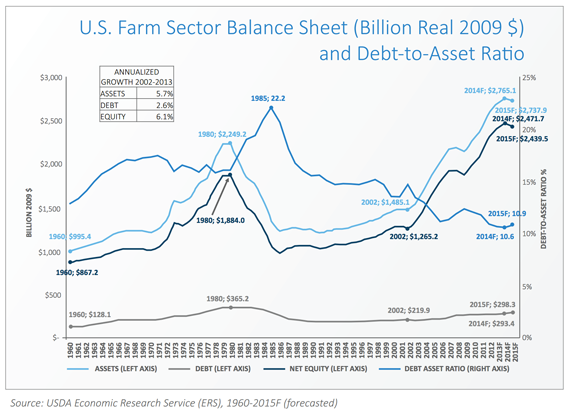 By comparison, the debt-to-asset ratio reached a 50-year high of 22.2% in 1985. Since then and through 2014, farmers have consistently improved their balance sheets with less debt and greater assets—with the exception of a few brief and slight reversals that reflected downturns in the general economy.
In addition, and very positive for agriculture, interest rates today are dramatically lower than in the 1980s, the article said.
AgriBank acknowledged in the article that the financial health of individual farms varies, and pockets of financial distress could arise if some circumstances persist. The bank also said that with nearly 82% of farm asset values in real estate, significant declines in farmland value could tip the balance sheet in the wrong direction.
AgriBank is one of the largest banks within the national Farm Credit System. The AgriBank District covers a 15-state area stretching from Wyoming to Ohio and Minnesota to Arkansas. About half of the nation’s cropland is located within the AgriBank District. S