

Court Finds New Hampshire ‘Dealer Bill of Rights’ Constitutional
Last week, the New Hampshire Supreme Court ruled against a challenge brought by makers of farm equipment to the state’s “dealer bill of rights.”
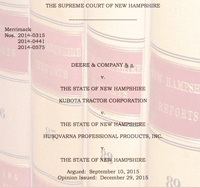 |
| Click on image for link to full decision |
Deere, Kubota, Husqvarna and others filed the challenge after 2013 revisions to the law broadened it to include makers of farm and construction equipment. The companies argued that the law, initially written to protect automobile dealers from excessive demands by automakers, shouldn’t be extended, in part because it interfered with the manufacturers’ existing franchise agreements.
The law requires manufacturers to show good cause before ending a dealer’s business, limits manufacturers’ ability to force dealers to sell their businesses, places limits on mandatory upgrades to facilities, and requires proper reimbursement for warranty work done by dealers.
The State Supreme Court upheld the trial court's decision in all material respects, saying in essence that RSA 357-C is constitutional and can be applied to all equipment dealer agreements, including those that already exist. This means that any member who wishes to set up a dealership in New Hampshire will be subject to the new law. Notably, the Supreme Court did agree that RSA 357-C’s limitation on arbitration provisions is unlawful, and therefore a broad arbitration provision will likely be enforceable.
Trent Johnson, our attorney who works with members on distribution contract issues, said this: “I am very serious with members when it comes to getting their dealer agreements in writing, and I almost always include broad arbitration provisions in the agreements that I draft for members. Frankly, this law makes arbitration provisions even more important, as they may provide an argument for avoiding resort to the Motor Vehicle Dealer Board for dispute resolution.”

We noted when we opposed the legislation in 2013 that the law provides targeted relief by exempting single-line equipment dealers who buy 90% of their product inventory from a single supplier and have annual average sales volume for the previous three years in excess of $100 million. That might be nice for a manufacturer like Caterpillar, but if they deserve an exemption, why not also exempt shortline farm equipment manufacturers?
Shortline manufacturers compete with great vigor for the independent dealer’s business in every state and province, and in no way do they possess the ability, history or desire to use coercion or intimidations to force a dealer into agreeing to one-sided language in a contract. In fact, the majors’ efforts to consolidate equipment dealers often leave the dealer group with the upper hand when it comes to negotiating contracts about termination, buyback, and warranty with shortline manufacturers.
Our Association and its members have always welcomed the opportunity to work with equipment dealers on issues that need to be addressed. Defining almost everything our members manufacturer as a “motor vehicle,” brings up an entire list of titling, registration and tax issues which set a horrible precedent.
While we are told the nation should look to citizens of the Granite State to vet prospective candidates for president, we clearly should not look on the efforts of the New Hampshire legislature for leadership when it comes to private contracts between a manufacturer and distribution partner. Let’s hope the citizens who claim the motto “live free or die” do a better job picking presidential candidates next month than they have in selecting lawmakers and members of the courts.