

Ninety-Nine Week Habits Hard to Break
The Organization for Economic Cooperation and Development (OECD), recently warned that lengthy spells many Americans are spending without work risk leaving a lasting scar of higher unemployment on the U.S. economy, and training programs are needed to avert the damage.
In a report on the U.S. economy, OECD estimated the unemployment rate which the economy could sustain without generating inflation at 6.1%, up from 5.7% in 2007. In May, the rate stood at 8.2%.
“However, structural unemployment may well already have risen more than this estimate would suggest, and there is a risk that it could increase still further, given the still high levels of long-term unemployment,” the OECD said.
Unusually long bouts of unemployment are often blamed for eroding both skills and workers attachment to the labor force.
“We still have a good bit of cyclical unemployment, which is best addressed by supporting aggregate demand,” Wendy Dunn, the OECD’s economist for the United States, told reporters.
“Education and training are key to improving skills, (and) reducing mismatches” between employer needs and workforce skills,” the OECD said.
The OECD also tied the drop in the labor force to easier eligibility requirements for disability benefits. It noted that the share of the working age population between the ages of 20 and 64 enrolled in disability programs rose to 6.6% in 2010 from 6.1% in 2007.
“Efforts are needed to reduce the reliance on disability benefits because few of the recipients ever return to the workforce,” the OECD said.
Many have questioned the wisdom of extending unemployment benefits to 99-weeks, believing it is causing some to refuse entry level positions in favor of unemployment checks.
The OECD seems to agree, urging that the duration of jobless benefits be pared back gradually towards its pre-recession baseline of 26 weeks.
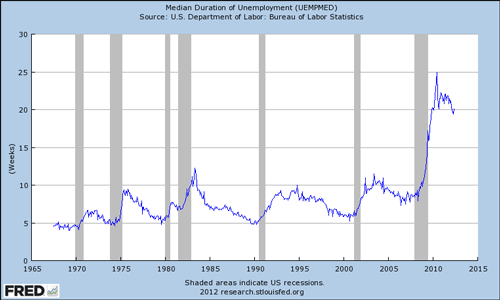
The median duration of unemployment is currently 20.1 weeks, down from the 25 weeks touched in June 2010.