

Rural Mainstreet Shows Progress Amid Continued Struggle
The Rural Mainstreet Index for March shows the struggle continues in rural communities, but it also offers encouragement. Some of the numbers appear to be moving in a positive direction.
The overall index, which ranges between 0 and 100, was 45.3 for March. That is a slight dip from February but a considerable improvement from a year ago, when the index was 40.6.
The March farm equipment-sales index increased to 22.0 from 20.5 in February. The index is still weak, but this is the fifth straight month that the reading has advanced.
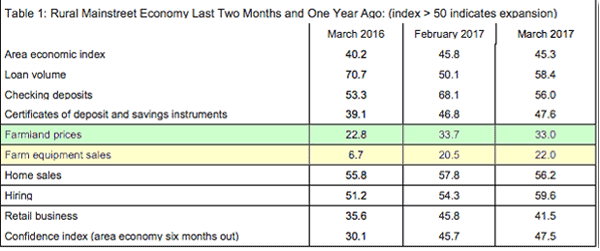
The confidence index, which reflects expectations for the economy six months out, rose to 47.5 from 45.7 in February, indicating a continued pessimism among bankers. “Until agricultural commodity prices begin to trend higher, I expect bankers’ economic outlook to remain weak,” said Ernie Goss, who is a professor and the chair of regional economics at Creighton University, which leads the study.
Each month, community bank presidents and CEOs in nonurban agriculturally and energy-dependent portions of a 10-state area respond to the survey from Creighton, which seeks data on current economic conditions in their communities.
In a state-by-state look at the data, three states recorded increases over February in the overall index. They were Colorado, Kansas and Missouri. States that saw a dip compared to February were Illinois, Iowa, Minnesota, Nebraska, North Dakota, South Dakota and Wyoming.
Two categories in the index were growth positive.
The job gauge rose to 59.6 from February’s 54.3. Businesses not linked to agriculture increased hiring for the month at a solid pace. And, the home sales index came in at 56.2, a dip from February’s reading but still an indication of economic expansion.