

University of Arizona Automated Lettuce Thinner Reduces Cost & Increases Efficiency for Vegetable Growers
When Mark Siemens joined the University of Arizona (UA) Faculty in 2008, he started looking for an automation project that would make a difference in the Yuma agricultural community. It wasn’t long before he learned of the labor challenges associated with weeding and thinning for local vegetable growers. With that in mind, Siemens and other UA researchers partnered with Ryan Herbon of Mule Deer Automation to develop an automated system for selective thinning of lettuce plants.
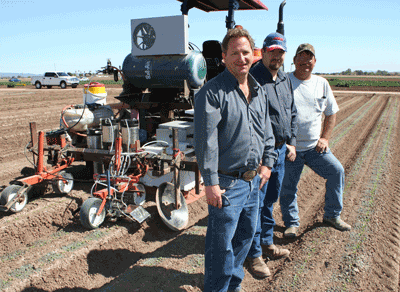 The UA lettuce thinner utilizes several novel technologies to deliver its consistently reliable performance. The first challenge the team had to tackle was the problem of how to identify the correct plants for selective thinning. The solution they came up with was a new machine vision system developed by Mule Deer Automation and the UA.
The system utilizes a digital camera to continuously monitor the ground and plants beneath the thinner. Through the use of proprietary algorithms, the system identifies the location of each plant in real time and determines which plant to terminate based on pre-set, user control inputs. The machine vision component is critical not only because it is the best way to detect the seedlings, but also because the decision of which plant to thin is not straightforward. Plant spacing is most important, however uniformity in plant size is also of interest to growers. When two seedlings are adjacent, it is desirable to terminate the one that is abnormally sized. The UA machine vision system is able to perform this function with a very high degree of accuracy.
The other breakthrough developed by the team is the method of termination. Numerous methods were tried including a mechanical knife, a ‘hula-hoe’, and pressurized water. The team eventually settled on a sprayed herbicide for most applications. The primary advantage of the spraying system is that it will not disrupt the soil. The resulting challenge, however, is how to spray the plants targeted for termination without affecting its neighbors. After painstaking months of trial and error, The UA team developed a nozzle design without drip or time delay, resulting in a tight, rectangular spray pattern that leaves adjacent plants unaffected.
Designs, software, and a working prototype have been developed and field tested. Several aspects of the technology are patent pending. The University of Arizona is now exploring commercialization opportunities for this technology. Interested parties can contact Chris Snyder in the Office of Technology Transfer by phone at (520) 626-4604 or by email at csnyder@ott.arizona.edu. ◆