

Wisconsin IOH Proposals Too Wide For Farm Equipment
A year long state effort in Wisconsin to examine damage to rural roads caused by high-frequency animal waste transport, at times when roadbeds are most susceptible to harm, has gone seriously off track, and now needs the direct attention of state elected officials to protect agricultural interest in the state.
As is the tendency of such groups, the Implements of Husbandry (IoH) Study Group greatly expanded its scope to include nearly all categories of farm equipment which have historically been considered exempt from permits and regulatory controls.
Before we address their proposals, it is important to look at some key wording in the form of exemptions and carve outs in the Wisconsin statutes chapter 348:
Width: “No limitation for implements of husbandry temporarily operated upon a highway in the course of performance of its work.”
Height: “Implements of husbandry of any height may be temporarily operated upon a highway without a permit for excessive height.”
Length: “No limitation for implements of husbandry temporarily operated upon a highway.”
Now drop the exemptions and carve outs for farm equipment and look at the proposal released in August for public comment, which recommends limits to the “envelope” for IoH:
-
Width would be 15 feet, but a width of up to 17 feet could be operated without written authorization when the operator meets safety requirements.
-
Height would be limited to 13 feet, 6 inches.
-
The proposed length envelope is 60 feet for a single IoH; 100 feet for combinations of two IoH; and 70 feet for combinations of three IoH.
- Implements would be given an expanded 15% weight allowance over the limits that are established by the federal bridge formula, except where posted and during periods of spring thaw. This equates to a maximum single axle weight of 23,000 pounds and a gross vehicle weight of 92,000 pounds.
One recommendation that draws the ire of the farmers and implement dealers who recently attended town hall meetings would force them to get written authorization to exceed size envelope and weight limits on an annual basis from the “maintaining authority of that roadway”. This raises even more questions regarding the proposals.
- Who issues the permits?
- Are permits needed in every township or county that they operate in?
- How do manufacturers deliver equipment to dealerships and dealers to the farm. How frequently do permits need to be issued/requested?
We are not alone in being disturbed by the Study Group’s proposals. AEM has called on Wisconsin to redirect the efforts of the Study Group. “If this initiative was allowed to continue as is, the scope creep could result in numerous new regulatory burdens placed on Wisconsin farmers, ranchers and dairymen, equipment dealers and equipment manufacturers,” AEM stated.
The Wisconsin Farm Bureau has noted its concern that there is no mention of a grandfather allowance or time frame for any of the equipment whose measurements exceed Report’s recommendations. “Thousands of Wisconsin farmers have millions of dollars invested in equipment that is in use and very functional that will require a permit according to the recommendations of this report.”
Rory Rhinesmith of the Wisconsin Department of Transportation (DOT) which chaired the IoH Study Group has said, “We want the legislature to see the full range of comments.”
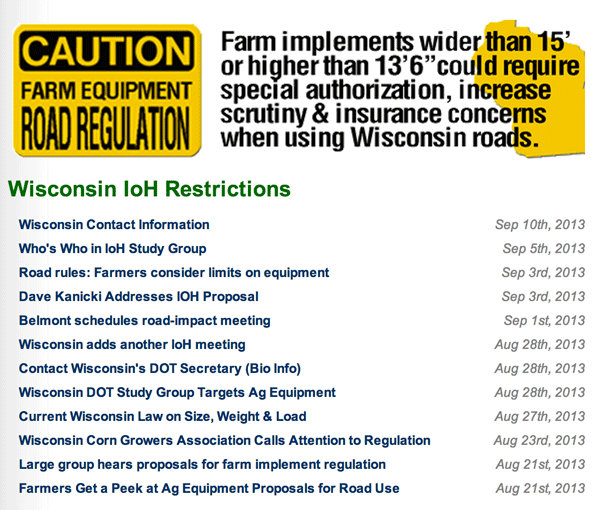 We agree with Rhinesmith’s desire for the legislature to see a “full range of comments” before any action is taken in Wisconsin or in other states which are sure to be watching the outcome in Wisconsin. We have urged state officials to carefully consider the negative effect new regulations will have on all parties involved before making any final recommendations to the state legislature.
We encourage members to visit a web page we have created to provide contact information and updates on this important issue. FarmEquip.org/IOH.